
How R1,000 a Month Became R232,000, By Doing Absolutely Nothing
Let’s talk about a guy called Sipho. Sipho isn’t a genius stockpicker. He doesn’t watch the business news every night, and he definitely doesn’t know what “the rand weakened against a basket of currencies” means, and honestly, neither do most people. In January 2016, Sipho started putting R1,000 a month into a simple JSE-tracking investment, the kind almost any retirement annuity, unit trust, or tax-free savings account can hold. Then he did the single hardest thing in investing: nothing. No panic selling, no clever timing, no trying to jump out before the bad news and back in after the good news. Just R1,000 a month, every month, for ten years.
By the end of 2025, Sipho had put in R120,000 of his own money. His investment was worth roughly R232,000.
That’s not a sales pitch. That’s what actually happened to the JSE Top 40 (the 40 biggest companies on the Johannesburg Stock Exchange, and the most common way ordinary South Africans get exposure to “the market”) between 2016 and 2025. This article walks through exactly how that happened, why it wasn’t a smooth ride, and why the biggest risk to Sipho’s money was never the market itself. It was the temptation to fiddle with it.

Ten Years Is a Long Time to Do Nothing. Here’s What It Actually Felt Like
Look at that gap between the two lines. For the first two years, they’re almost sitting on top of each other. That’s because 2016 and 2018 were genuinely bad years for the JSE. The market fell in 2016, and then fell hard again in 2018, down almost 13% for the year. If Sipho had checked his statement at the end of 2018, his investment would have looked barely better than if he’d just kept the cash under his mattress.
This is the moment that gets people. This is exactly when a lot of investors decide the whole thing isn’t working, stop their debit order, or pull their money out to “wait until things settle down.” It’s a completely understandable instinct. It’s also, based on what actually happened next, the single most expensive decision Sipho could have made.
Because 2025 happened. The JSE Top 40 had its strongest year in this entire ten-year stretch, up more than 43%. Sipho’s investment didn’t creep past his contributions, it leapt past them, going from being worth about what he’d put in, to being worth almost double what he’d put in, largely in that one extraordinary year.
Here’s the uncomfortable truth underneath that chart: nobody rings a bell to tell you 2025 is coming. The people who got that final surge were, almost without exception, the same people who sat through the flat, boring, occasionally scary years that came before it. You don’t get invited to the good years. You only get to be there for them if you never left.
Now Here’s the Dangerous Part: What Happens If You Try to Be Clever?
Staying invested through the bad years is hard. So a lot of people don’t. They try to be smart about it instead: sell when things look shaky, and buy back in once things look safe again. It sounds sensible. In practice, it’s one of the most reliably damaging things an investor can do to their own money, and there’s real, recent South African research showing exactly how damaging.
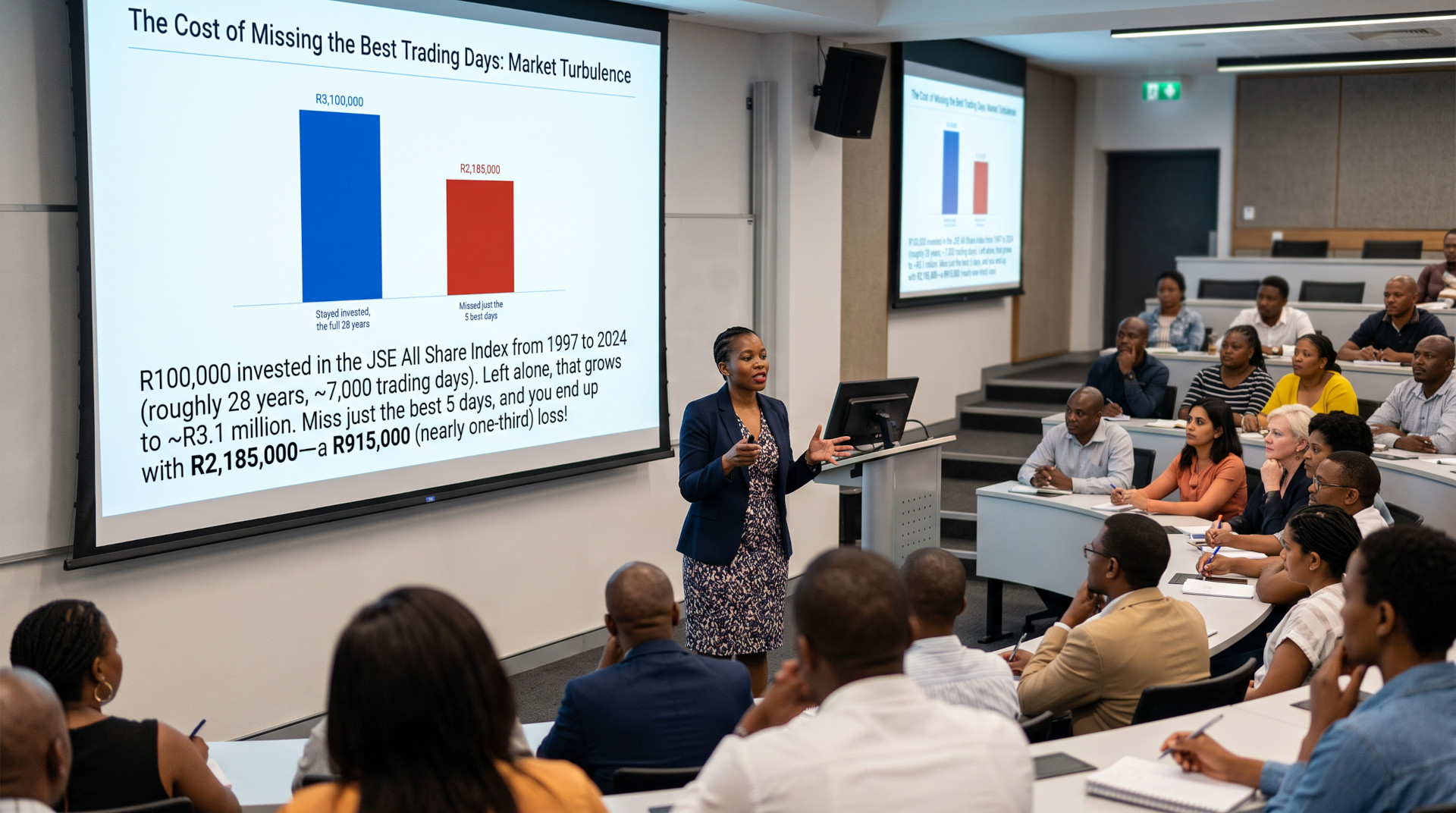
A Sanlam financial adviser presentation, citing Investec Wealth & Investment and Iress, shows what would have happened to R100,000 invested in the JSE All Share Index from 1997 to today, roughly 28 years, about 7,000 trading days. Left completely alone, that R100,000 grows to about R3.1 million. But miss just the single best 5 days out of those 7,000, five days, not five years, and you end up with about R915,000 less, nearly a third lower than if you’d simply done nothing.

R100,000 invested in the JSE All Share Index, 1997 to 2025. Source: Sanlam financial adviser presentation, citing Investec Wealth & Investment and Iress.
An older but complementary version of the same lesson, from Investment Solutions using I-Net Bridge data, tracked R100 invested in the JSE All Share Index from 1995 to 2014. Left alone, it grew to R1,760. Miss the 10 best days out of that 20-year stretch, and it only grew to R965. Miss the 60 best days, and it grew to just R143, barely more than the original R100. Different time periods, different data providers, same result: a tiny handful of days out of thousands does almost all the work.
Why Missing Just a Few Days Does So Much Damage
This isn’t a coincidence, and it isn’t bad luck. It’s how markets actually behave. The best days and the worst days tend to happen right next to each other, in the same short, scary, volatile stretches. Think back to March 2020, when the Covid crash hit. Some of the worst days in JSE history happened that month. So did some of the best days, as the market violently rebounded within days or weeks of the bottom.
If you sell when it’s scary, you lock in the loss. If you then wait for things to “feel safe” before buying back in, you miss the rebound, because the rebound almost always happens before things feel safe again. It happens while everyone is still nervous. By the time it feels obviously safe to get back in, you’ve usually already missed the best part of the recovery. Trying to dodge the bad days, in practice, means dodging the good days too, because they’re the same days.
This Is the Same Idea as Compounding, Just From the Other Direction
You’ve probably heard that compound growth is one of the most powerful forces in investing: you earn returns not just on the money you put in, but on the returns you already earned, which then earn their own returns, and so on. It’s why the last few years of a long-term investment usually add more value than all the earlier years combined, which is exactly what you can see happening in Sipho’s chart above, most of his growth arrived in the final year.
But compounding has one requirement that people underestimate: it needs an unbroken run. Every time you pull your money out and put it back in later, you don’t just miss a few days of returns, you reset the clock on the compounding that was already happening. The R100 that grew into R1,760 over twenty years didn’t do that by growing steadily. It did it by being left alone long enough for a handful of extraordinary days to do most of the heavy lifting. Take those days away, even just 10 or 60 out of 5,000, and you’re not slightly worse off, you’re back to almost nothing.
Staying invested isn’t the opposite of compounding. It’s the condition compounding needs in order to work at all.
What This Actually Means for Your R1,000 a Month
You don’t need to predict the next crash. You don’t need to know when to get back in. You don’t need to watch the news every night. What Sipho’s ten years shows, using real numbers from the real JSE, is that the single most powerful thing an ordinary investor can do is also the simplest: set up the debit order, and then leave it alone, including and especially during the years it doesn’t feel like it’s working.
The bad years are not a sign that it’s broken. They’re the price of admission for the good years, and history suggests you cannot reliably have one without sitting through the other.
Key Takeaways
- A real R1,000 a month invested in the JSE Top 40 from 2016 to 2025 grew from R120,000 contributed to roughly R232,000, an annualised return of about 8.7%
- Most of that growth arrived in the final year of the ten, after several flat or negative years that came first
- Published South African research shows that missing just the 10 best trading days over a 20-year period can nearly halve your final investment value, and missing the 60 best days can wipe out almost all the growth
- The best and worst trading days cluster together in the same volatile periods, which is why trying to dodge the bad days usually means missing the good days too
- Compounding needs uninterrupted time to work. Jumping in and out doesn’t just cost you a few days of returns, it resets the growth that was already building
- The most reliable strategy for an ordinary monthly investor is also the simplest: keep contributing, and don’t stop because a particular year looks bad
Frequently Asked Questions
Is this saying I should never check on my investments?
No. Reviewing your investment strategy, your fees, and whether your goals have changed is healthy and worth doing periodically, ideally with a financial adviser. What the research above warns against specifically is reacting to short-term market drops by selling out and trying to time your way back in, which is a different thing from a considered, periodic review.
What if the next ten years aren’t as good as 2016 to 2025?
They might not be. Past performance is never a guarantee of future performance, and the JSE’s actual returns over the next decade could be lower, higher, or arrive in a completely different pattern. The point of this example isn’t that the JSE will always return 8.7% a year. It’s that trying to dodge the bad periods within any long-term investment tends to cost investors more than simply staying invested through them.
Why does R1,000 a month matter more than a lump sum?
It doesn’t have to be R1,000 specifically, the principle applies to any regular contribution or lump sum. R1,000 a month was used here because it’s a realistic, achievable amount for an ordinary earner, and because debit-order investing is how most South Africans actually build retirement savings, through a retirement annuity, tax-free savings account, or unit trust.
Does this apply to retirement annuities and tax-free savings accounts too?
Yes. The underlying investments inside many retirement annuities and tax-free savings accounts include JSE-linked funds, so the same time-in-the-market principle applies. The specific tax treatment differs between account types, but the case for staying invested rather than trying to time entries and exits is the same.
What should I do if I’m nervous during a market downturn?
Speak to a licensed financial adviser about your specific situation before making any changes to your investments. What the data above suggests, in general terms, is that reacting to a downturn by selling out has historically cost long-term investors more than it has protected them, but your own circumstances, timeline, and risk tolerance should guide any decision, not a general rule alone.
Related posts:
 Why patience pays & how staying invested beats market timing every time
 Financial market instability and your retirement strategy
 SA Pension Fund Performance Review H1 2026: Key Winners, Losers, and Market Implications for Investors
 Planning for retirement with Fixed Income Investments
 How to retire as a millionaire and not have to worry